Ayia Napa Monastery
Ayia Napa is famous for beaches, boat parties, and nights that accidentally turn into mornings.
But right in the middle of all that energy sits something completely different: the Ayia Napa Monastery.
Calm, historic, and surprisingly beautiful, it’s one of the most important landmarks in the town — and a place many visitors walk past without realizing its story.
If you’re visiting Ayia Napa, taking a few minutes to explore the monastery is one of the easiest ways to connect with the town’s past.
And yes, it’s located right next to the famous nightlife square, which makes the contrast even more interesting.
The Story Behind the Name “Ayia Napa”
The monastery is actually where Ayia Napa got its name.
The words come from Greek:
Ayia (Agia) = Holy
Napa = Forest or wooded valley
Legend says that centuries ago, this area was covered in thick forest.
According to local tradition, a hunter discovered an icon of the Virgin Mary hidden inside a cave here. The site was considered sacred, and eventually a monastery was built around it.
In other words, before Ayia Napa became a beach resort and nightlife hotspot, it was known as a quiet religious retreat in the forest.
A Monastery from the Venetian Era
The current structure of the monastery dates mainly to the 15th century, when the Venetians ruled Cyprus.
The architecture reflects this history:
Thick stone walls
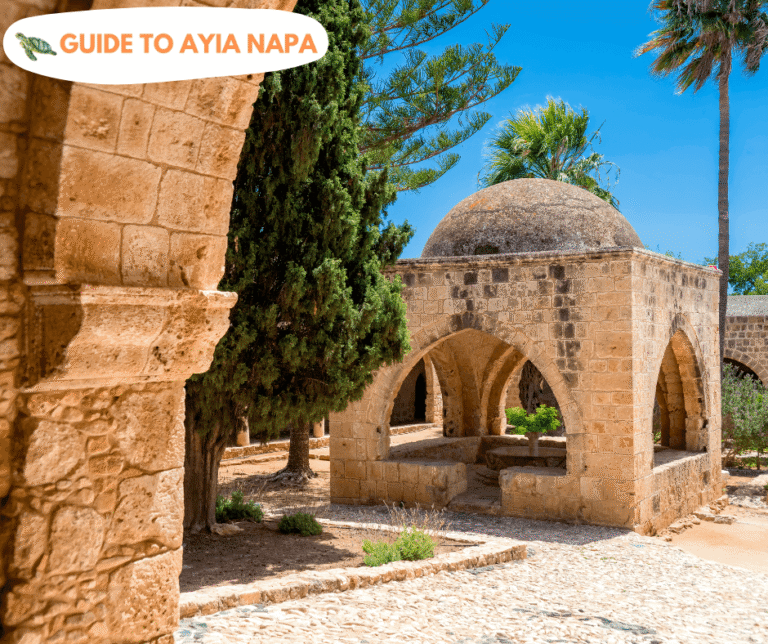
A rectangular courtyard surrounded by arches
A small medieval church
A partially underground cave chapel
Walking through the courtyard today feels a bit like stepping into a time capsule. Outside the walls, you’ll hear music, scooters, and beach chatter — but inside, it’s peaceful and shaded by ancient trees.
The Famous Sycamore Tree
One of the most iconic sights in the monastery courtyard is the giant sycamore tree.
Local tradition says the tree is over 600 years old, suggesting it may have been planted around the time the monastery was built.
Its massive trunk and branches provide shade over the central courtyard, making it one of the most photographed spots in Ayia Napa.
It’s also the kind of tree that makes you pause for a second and think: “This thing was already here before Columbus sailed to America.”
The Underground Cave Chapel
The most mysterious part of the monastery is the cave chapel, which is believed to be the original sacred site.
According to legend, this is where the miraculous icon of the Virgin Mary was discovered.
The cave became a place of pilgrimage long before the monastery complex was constructed.
Today, visitors can still see:
The small rock-cut chapel
Religious icons and candles
Stone walls carved directly into the natural cave
It’s quiet, atmospheric, and very different from the bright Mediterranean sun outside.
The Monastery and the Noblewoman Legend
Another popular legend tells the story of a Venetian noblewoman who built the monastery.
According to local tradition, she fell in love with a man her family did not approve of. When their marriage was forbidden, she decided to become a nun and funded the construction of the monastery where she would live in seclusion.
Whether the story is entirely true is debated, but it adds a romantic — and slightly tragic — twist to the monastery’s history.
From Monastery to Cultural Landmark
The monastery stopped operating as a religious community centuries ago, but the church itself remained important to residents.
Today, the complex functions mainly as:
A historic monument
A religious site
A venue for cultural events and festivals
The square outside the monastery often hosts celebrations and gatherings, especially during religious holidays.
The Most Peaceful Spot in the Busiest Part of Ayia Napa
One of the funniest things about Ayia Napa Monastery is its location.
It sits right next to Ayia Napa Square, the same area known for bars, clubs, and nightlife.
During the summer,r you might see people taking photos of the monastery while others walk past in beach clothes on their way to the next bar.
And somehow, it works.
Inside the wall, ls you’ll find quiet, shade, and history — a surprising contrast to the lively energy just a few meters away.
Visiting Ayia Napa Monastery
The good news: visiting the monastery is incredibly easy.
Location:
Ayia Napa Square is in the center of town.
Entrance fee:
Free.
Time needed:
About 15–30 minutes.
It’s the perfect short stop while exploring the center of Ayia Napa. Many visitors combine it with nearby attractions such as restaurants, cafés, or a walk to the harbor.
Why You Shouldn’t Skip It
Ayia Napa Monastery might not have water slides, DJs, or boat parties — but it offers something just as valuable: a glimpse into the town’s history.
In less than half an hour, you can see:
A 15th-century monastery
A legendary underground cave chapel
A tree that’s been standing for 600 years
The place that gave Ayia Napa its name
And honestly, it’s pretty cool to say that you visited a medieval monastery in the middle of one of Europe’s most famous party towns.
| Visitor Information | Details |
|---|---|
| Attraction Name | Ayia Napa Monastery |
| Location | Ayia Napa Square, right in the center of Ayia Napa |
| Entrance Fee | Free entry |
| Estimated Age | Mainly dates back to the 15th century, so it’s around 600 years old |
| Why Visit | To see one of Ayia Napa’s most historic landmarks, a peaceful courtyard, a cave chapel, and a famous ancient sycamore tree |
| Atmosphere | Quiet, historic, and peaceful — which is quite impressive considering it sits next to the town’s lively nightlife area |
| Highlights | Medieval architecture, underground cave chapel, central courtyard, old stone arches, and the legendary sycamore tree |
| Time Needed | Around 15–30 minutes |
| Best For | History lovers, photographers, curious travelers, and anyone who wants a culture break between beaches and bars |
| Good to Know | It’s an easy stop while exploring the town center, and it pairs well with a walk around Ayia Napa Square, the harbour, or nearby cafés |
How much does it cost to visit Ayia Napa Monastery?
Good news for budget travelers: visiting Ayia Napa Monastery is completely free.
There is no entrance fee, ticket booth, or booking required.
You can simply walk in and explore the courtyard, the church, and the cave chapel.
This makes it one of the easiest cultural stops in Ayia Napa.
Whether you’re passing through the square during the day or taking a break from the beach, you can step inside and experience a piece of the town’s history without spending a single euro.
How old is the monastery in Ayia Napa?
The current monastery complex was mainly built in the 15th century, when the Venetians ruled Cyprus.
That makes the monastery around 600 years old.
However, the site itself is believed to be even older.
According to local legend, a sacred icon of the Virgin Mary was discovered in a cave here long before the monastery was constructed, and the cave chapel became an early pilgrimage site.
So while the buildings visitors see today date back about six centuries, the religious significance of the location may go back even further.
Address:
- Monastery of Ayia Napa
Contact:
Opening Hours:
- Daily: 09:00 – 15:00 (Winter)
- Daily: 09:00 – 20:00 (Summer)
Entrance Fee:
- Free